Boston Jobs Report: Health Care and Construction Grow While Tech and Logistics Shrink
BOSTON, MA — The September jobs numbers for Greater Boston are quiet on the surface and busy underneath. Total employment across the metro barely budged over the past year, but the hiring has moved. Hospitals in the Longwood Medical Area and construction crews from the Seaport to Somerville are adding workers, while tech, retail and logistics employers have pulled back. If you are job hunting anywhere inside Route 128 this fall, that shift matters more than any headline rate.
Health care and construction are growing in the Boston metro. Tech, logistics and hospitality are shrinking. Here is what the latest federal and state data show, and where to point your search.
Ready to search? Skip straight to the job links for the sectors adding workers →
Boston Metro Jobs in September 2026: Flat Overall
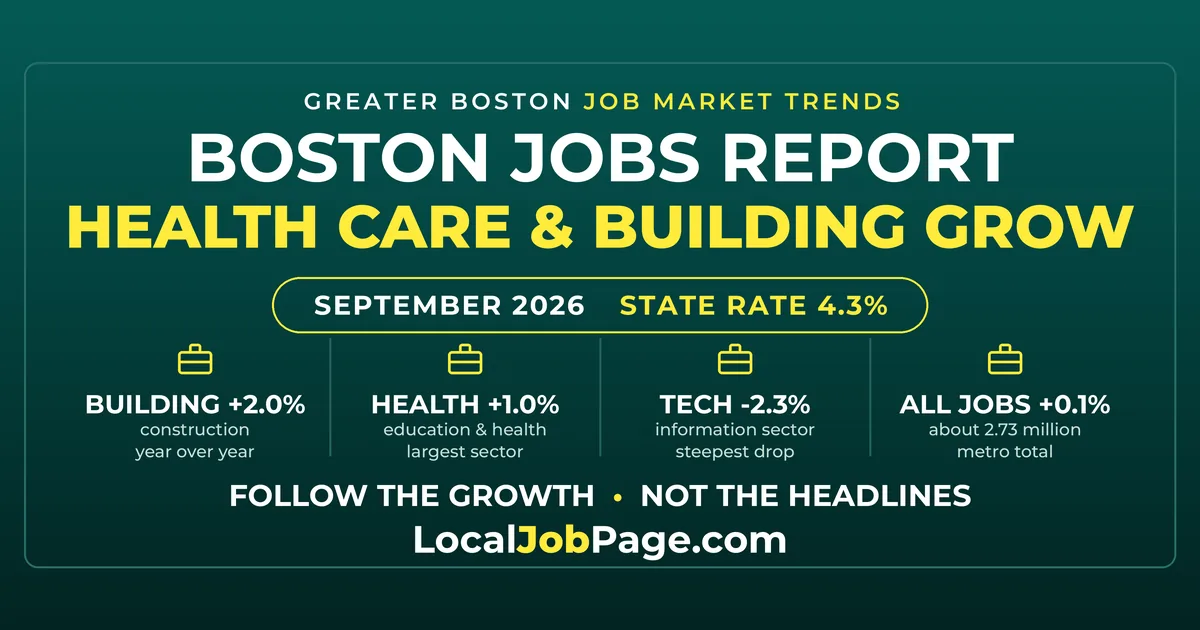
According to the U.S. Bureau of Labor Statistics, the Boston-Cambridge-Newton metro, which stretches into southern New Hampshire, counted about 2,733,800 nonfarm jobs in September. That is up just 0.1% from a year earlier. The figure is preliminary and not seasonally adjusted.
The most recent metro unemployment rate BLS lists is 4.1% for August, down from 4.3% in July. September's metro rate had not been posted on that page at publication time.
Where Boston-Area Jobs Are Growing
Comparing September 2026 with September 2025, a few sectors stand out:
- Construction: up 2.0%. The fastest-growing sector in the metro over the past year.
- Other services: up 1.6%. Repair shops, personal services and similar local businesses.
- Education and health services: up 1.0%. The metro's largest sector by far, with roughly 623,000 jobs, and the one that includes hospitals, clinics and long-term care.
- Financial activities and manufacturing: up 0.5% and 0.4%.
Where Jobs Are Shrinking
The information sector, which covers much of the region's software and media work, fell 2.3% over the year, the steepest drop of any sector. Trade, transportation and utilities, the group that holds retail stores and warehouses, slipped 1.3%. Leisure and hospitality was down 0.5%, and professional and business services dipped 0.3%.
The Statewide Picture
In the state's September jobs release, Massachusetts labor officials reported a preliminary gain of 3,500 jobs in September, following a revised loss of 5,600 in August. The statewide unemployment rate held at 4.3%, slightly above the national rate of 4.2%. Financial activities, professional and business services, and trade, transportation and utilities led the month's gains.
Over the year, the state has added 16,300 jobs, 13,000 of them in the private sector. The labor force grew by 8,400 in September, and participation stood at 65.4%, well above the national level.
The state's local labor market release adds a caution: those local figures are not seasonally adjusted, so September's month-to-month swings reflect the end of summer as much as any real trend.
What It Means If You're Job Hunting
Boston is not out of jobs. The openings have moved. Clinical and patient-care roles remain the steadiest lane, and several, such as medical assistant, phlebotomist and certified nursing assistant, can be reached through short training programs. The building trades are also adding workers, and they tend to reward hands-on skill over a degree.
If you are coming out of tech, retail management or a distribution center, search by skill rather than title. Scheduling, data, compliance, inventory and customer-facing work all translate into health systems, contractors and financial firms.
🔎 Start Searching Boston's Growing Sectors
These searches lean toward the sectors that added workers over the past year, from the Longwood hospitals to job sites along the Red Line.
Start here:
- Registered nurse jobs in Boston
- Medical assistant jobs in Boston
- Phlebotomist jobs in Boston
- Certified nursing assistant jobs in Boston
- Construction jobs in Boston
- Electrician jobs in Boston
- Financial analyst jobs in Boston
- Mass General Brigham jobs in Boston
- Boston Children's Hospital jobs
Frequently Asked Questions
What is the Boston unemployment rate right now?
The latest metro figure from the Bureau of Labor Statistics is 4.1% for August 2026, not seasonally adjusted. The Massachusetts statewide rate was 4.3% in September, seasonally adjusted.
Which Boston industries are growing fastest?
Construction grew 2.0% over the year, other services grew 1.6%, and education and health services, the region's largest sector, grew 1.0%.
Which sectors are losing jobs?
Information, which includes much of the tech industry, fell 2.3%. Trade, transportation and utilities fell 1.3%, and leisure and hospitality fell 0.5%.
When does the next jobs report come out?
Massachusetts and BLS publish new monthly figures a few weeks after each month ends, so October 2026 data should follow in November.
Follow the Growth, Not the Headlines
Create a free LocalJobPage account to set alerts for Greater Boston openings, and browse the Career Center for guides to health care roles and what they pay.
Employers: hiring in a sector that's growing? Post your openings on LocalJobPage and reach Boston-area job seekers ready to switch fields.
Related Reading
- Fall 2026 Boston Job Fairs & Hiring Events: Your Complete Guide
- Roxbury Community College Fall Career Fair Nov. 17: MassHire Members Must Register First
- Healthcare Jobs
- Medical Assistant Jobs
The towers around Kendall Square still matter, but this fall the busier hiring floors are along Longwood Avenue and at the job sites along Dorchester Avenue.